More companies want promotional products that reflect their values as well as their logo. Some teams want recycled or organic materials. Others want items made in Canada. Many want both.
The most practical place to find them is a supplier with a large catalogue that can also confirm the material and country of manufacture for each product before you order. Labels such as “sustainable” and “Canadian-made” can mean different things from one item to the next. They are worth checking product by product, not assuming.
PromotionalProducts.ca is a Canadian-owned, family-owned promotional products supplier that has served organizations since 1999. Its team offers expert support with customization, production, and logistics. That includes helping you narrow a large catalogue down to items that fit your values, your target audience, and your timeline.
This page covers where to look, what these labels mean on a promotional item, and how to confirm each claim before your logo goes on it.
Where to Look: Search Wide, Then Confirm Each Item
Start broad. A large catalogue gives you more room to find options in the product types your audience already uses, such as drinkware, bags, apparel, and office supplies. Search by the qualities that matter to you, such as recycled, organic, reusable, or made in Canada. Then build a shortlist of three to five items.
Next, narrow the list with your supplier. A product listing is a helpful starting point, but a listing alone is not proof. Ask your supplier to confirm two details for every item on your shortlist:
- Material: what the product is made from, and in what proportion if it is a blend
- Country of manufacture: where the item itself is made
Keep the items that hold up and drop the ones that do not. It is easier to change a product early than to change your message after the order arrives.
Canadian-Made, Canadian-Decorated, or Canadian-Owned Supplier: What Each Means
These three phrases are often grouped together. On a promotional item, they describe three different things.
- Canadian-made means the product itself was manufactured in Canada.
- Canadian-decorated means the logo or design was applied in Canada, through printing, embroidery, engraving, or another method. The blank product may have been made somewhere else.
- Canadian-owned supplier describes the company you buy from. It tells you who sells and coordinates your order, not where the product was made or decorated.
A single item can carry one, two, or all three of these. For example, a tote bag might be manufactured outside Canada, decorated in Canada, and ordered through a Canadian-owned supplier. Once those details are confirmed, that bag supports “decorated in Canada.” It does not support “made in Canada.”
If made-in-Canada is a firm requirement for your program, say so at the start. Your supplier can then focus the search on items where Canadian manufacture can be confirmed, rather than items that only have a Canadian connection.
What Makes a Promotional Product Sustainable
“Sustainable” is a wide term. On promotional products, it usually comes down to three things: what the item is made from, how it was made, and how long it stays in use. The sections below look at each one.
1. Recycled Materials
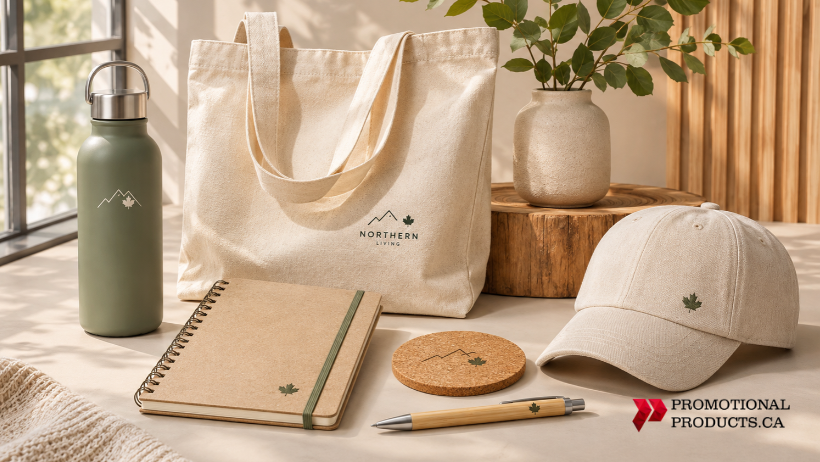
Recycled materials give plastics, fabrics, paper, or metals a second life in a new product. You may see this description on tote bags, backpacks, notebooks, pens, and apparel blends.
The detail that matters is how much of the product is recycled. A bag with a recycled body may still have handles, zips, or lining made from new material. A notebook may have a recycled cover and standard pages inside.
Look for: A stated recycled-content percentage tied to the exact item and colour you plan to order.
Giveaway idea: A recycled-material notebook for a lead generation campaign, with a short imprint on the cover and your website on the back.
2. Organic and Natural Materials
Organic cotton often appears in tote bags, t-shirts, and caps. The word “organic” usually describes how the raw fibre was grown. It does not, on its own, tell you where the finished product was made or how it was decorated.
Natural materials such as bamboo, cork, and wood often appear in desk and kitchen items. They can feel warm and giftable, but “natural” does not automatically mean durable or lower impact. The finish, the build, and how the item will be used still matter.
Look for: Documents from the manufacturer that support the organic or natural-material description for that specific product.
Best for: Client gifts and employee appreciation items where texture and feel are part of the experience.
3. Durable Construction That Keeps a Product in Use
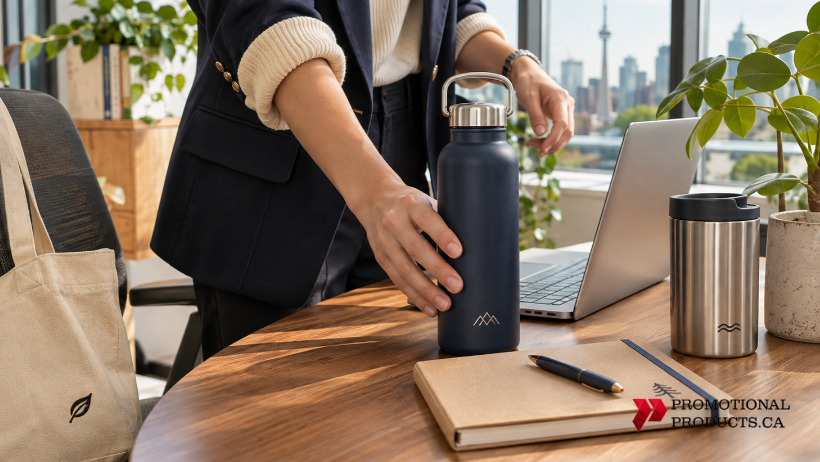
This is often the most practical sustainability point. A product that lasts, and that people want to keep using, can replace disposable items for months or years. A product that breaks or looks worn after a few weeks does not do that, no matter what it is made from.
Build quality decides whether a product stays in daily use:
- Drinkware: lids that seal well and hold up to daily opening and washing
- Bags: handles and stitching strong enough to carry groceries, laptops, or gym gear
- Apparel: fabric weight and seams that hold their shape through regular washing
- Decoration: an imprint or embroidery method suited to the product, so your logo lasts as long as the item does
From a promotional standpoint, durability is also where brand visibility comes from. Every time someone refills a bottle or carries a tote to the grocery store, your logo becomes part of their daily experience. A sturdy reusable bag carried for years often does more for your brand, and for your sustainability goals, than a recycled bag that tears after a month.
Ask for: Product details on lid type, handle construction, fabric weight, and decoration method before you approve the item.
Swap Single-Use Giveaways for Year-Round Items
When sustainability is the goal, one of the simplest changes is to replace a single-use giveaway idea with something people will reuse all year.
| Instead of | Consider | Why it works |
|---|---|---|
| Bottled water at your booth | A reusable water bottle | It goes to the desk, the gym, and the commute, and gets refilled daily |
| Disposable cups at an event coffee station | An insulated travel mug | It keeps working long after the event ends |
| Thin bags for handing out brochures | A sturdy tote bag | It becomes a grocery, library, or work bag |
| A seasonal novelty item | A neutral-colour apparel layer or notebook | It suits every month of the year, not one week |
| A printed handout on its own | A notebook with a short imprint | People keep it and write in it, so your brand stays in view |
The goal is not simply to give something reusable. It is to give something your target audience will actually reuse, based on how they live and work.
Branding idea: Choose a reusable bottle in a neutral colour with a one-colour logo and a short line such as “Refill. Reuse. Repeat.”
Your Per-Product Verification Check
Before you approve any item that you plan to describe as sustainable or Canadian-made, run this check for that product. Repeat it for every item, even within the same order.
- Material spec. Get a written description of what the exact item, colour, and size is made from, including any recycled or organic content percentage.
- Origin paperwork. Confirm the country of manufacture for the product, ideally supported by information from the manufacturer. If you also want to mention where it was decorated, confirm that separately.
- Certification documents. If the product is described with a third-party certification, ask for a copy or a clear reference you can check. If no document is available, leave the certification out of your messaging.
- Match the record to the order. Make sure the details apply to the exact item, colour, and size in your quote. If anything changes, such as a new colour or a substitute product, confirm the details again.
- Save the file. Keep the paperwork with your order records so your marketing, procurement, and customer service teams can refer to it when questions come up.
Information can vary from one product to another, and some items will have more detail available than others. If an item cannot be confirmed, you have two practical options: choose a confirmed alternative, or use the item without the claim.
How to Word Your Message Without Overclaiming
Once your products are confirmed, the next step is describing them accurately on the item, on packaging, and in your campaign. A few principles help:
- Be specific. Name the material or origin you confirmed instead of using a broad label.
- Claim the part, not the whole. If only the body of a bag is recycled, say so.
- Keep product claims with the product. One Canadian-made mug does not make a whole kit Canadian-made.
- Choose use-based lines when in doubt. An imprint about reuse describes how the item is meant to be used, not where it came from.
| Instead of | Try (once confirmed) |
|---|---|
| “Eco-friendly tote“ | “Tote made with recycled cotton” |
| “Made in Canada” on an item only decorated here | “Decorated in Canada” |
| “Our sustainable welcome kit” | “This kit includes a reusable bottle and a recycled-material notebook” |
| “Proudly Canadian” on every item | “Made in Canada” only on the items where it applies |
| “Zero-waste giveaway” | “A reusable item made for everyday use” |
The same care applies to campaign copy, such as social posts, booth signs, email announcements, and gift cards. If a line could be read as a claim about the product, make sure your file supports it.
Branding idea: For a client gift, pair a reusable mug with a short card explaining why you chose it and what you confirmed about it, such as its material or where it was made. A specific, honest note makes the gift feel more personal and intentional.
Planning the Rest of a Verified Order
Sourcing is one part of the order. These related topics are covered in more depth on their own pages.
General buying criteria. Beyond material and origin, you will also want to confirm audience fit, artwork, proofs, quantities, and delivery.
Choosing a specific gift. If you are selecting a gift for a smaller, high-value group, a side-by-side look at options can help.
Timelines. Items with specific material or origin requirements can mean fewer options to choose from and extra time to confirm details.
Apparel sizing. Fabric content can affect how a garment fits and feels, so check the size chart for the exact organic or recycled-fabric piece you choose.
Logo files. Textured surfaces such as cork, wood, or recycled fabric can affect which decoration method works best.
Frequently Asked Questions
Can one promotional product be both sustainable and Canadian-made?
It is possible, but treat them as two separate checks. Confirm the material details and the country of manufacture independently, and only describe the item with the qualities you can support.
Is a reusable product automatically a sustainable choice?
Not automatically. Reuse only matters if people keep using the item. A well-built product matched to your audience’s lifestyle is more likely to stay in daily use than one chosen for its label alone.
Can we print “Made in Canada” on an item that was only decorated here?
No. “Made in Canada” refers to where the product was manufactured. If only the decoration happened in Canada, “Decorated in Canada” is the accurate wording, once it is confirmed.
What should we do if the item we like cannot be confirmed?
Ask your supplier for a similar item where the details can be confirmed. If you still prefer the original product, use it without the sustainability or origin claim.
Do we need documents for every item in a mixed kit?
You need them for every item you plan to describe with a sustainability or Canadian-origin claim. Items you describe only by what they are, such as “a travel mug,” do not need that paperwork.
Useful, Verified, and Worth Keeping
Finding sustainable or Canadian-made promotional products starts with a wide search and a supplier who can confirm the details for each item. From there, know what each label actually means, run a quick check on every product, and word your message to match what you confirmed.
When a product is useful, well built, and accurately described, it becomes more than a giveaway. It becomes an everyday brand reminder that reflects what your company cares about.