The right promotional stationery products give customers something useful while keeping your business name close at hand. From notebooks to branded pens, choose items that suit your audience, budget, and campaign goals. Consider how recipients will use them, whether for daily office tasks, training sessions, or event giveaways.
Check writing comfort, paper quality, and printing options to ensure the products are practical and your branding remains clear. This guide explains how to compare products, assess quality, and plan a custom stationery order with Promotional Products Canada.
What Are Promotional Stationery Products?
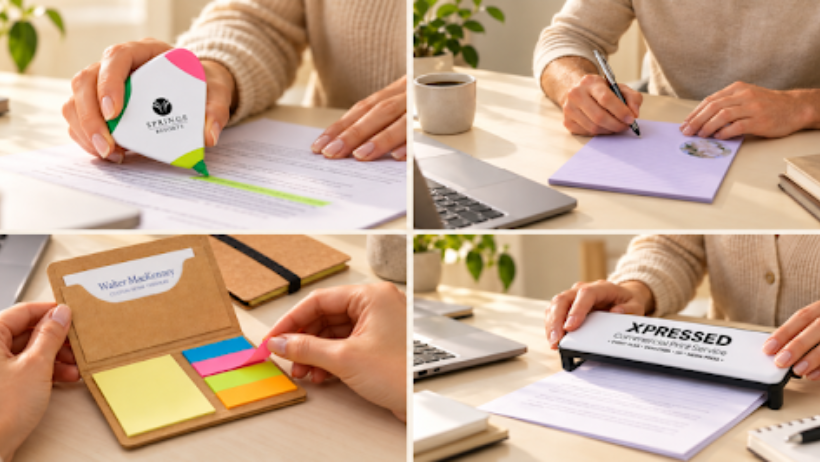
Promotional stationery products are writing and paper-based items customized with your logo, business name, or message. Common examples include pens, pencils, notebooks, sticky notes, folders, and planners.
Unlike a leaflet that someone may read once, useful stationery can remain on a desk or travel in a work bag. Its value depends on whether your recipient actually needs and enjoys using it.
These items also complement other promotional materials, such as brochures and welcome cards. A notebook can support a training session, while a branded folder keeps your information together after a meeting.
Why Useful Stationery Deserves a Place in Your Marketing
Stationery can support business communication by giving recipients a useful item associated with your organization. A pen used during meetings or a notebook kept on a desk may keep your branding visible during ordinary work activities.
However, distribution alone does not guarantee stronger brand recognition or additional sales. Choose products that fit the purpose of your campaign, and decide how you will assess its results before placing an order.
Focus on three priorities: usefulness, product quality, and clear branding. These considerations help you choose stationery that serves a practical function without making the promotional message intrusive.
Match Your Stationery to the Person Receiving It
Choose stationery based on your audience’s needs. Office employees may prefer pens and notepads, conference attendees may need compact notebooks, and clients may appreciate folders for organizing documents. Check writing comfort, paper quality, binding, and overall practicality before ordering.
For Conferences and Business Events
Choose lightweight notebooks and reliable pens that attendees can use during presentations and workshops. Keep logos clear but leave enough space for writing. If you include a QR code, test it before approving the design.
For Employee Welcome Kits
Pair a notebook and pen with a welcome card containing useful information. For remote employees, consider package size, weight, and shipping costs. Select items that suit employees’ daily tasks rather than adding unnecessary accessories.
Check Quality Before You Commit to a Bulk Order
Product photographs cannot show everything about writing comfort or paper performance. Request a sample when possible and test it under the conditions your recipient will encounter.
Visit the website to check whether pre-production samples are available for your selected product. Review the ordering information or contact the team to confirm any applicable charges, preparation time, and whether the sample includes your proposed decoration before placing your order.
Paper and Binding
Paper weight, often measured in grams per square metre (GSM), can help you compare notebooks, but it does not tell you how the paper performs with different inks.
Write on both sides using the pen you plan to supply. Check for ink showing through, feathering, and uncomfortable page texture.
For binding, consider how the notebook will be used. Spiral binding often allows pages to fold back, while other formats may suit a more formal presentation; test whether your chosen notebook opens comfortably.
Pens and Notepads
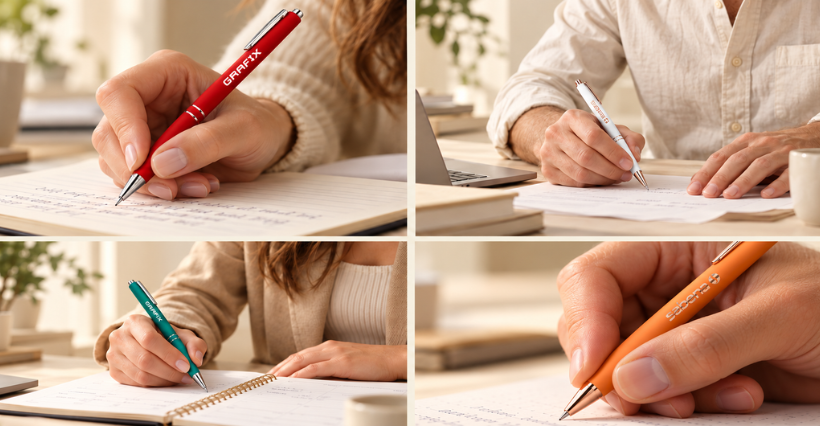
Test whether the pen starts writing promptly and feels comfortable during longer writing sessions. Check its clip, cap, or click mechanism, and whether refills are available if refillability matters to your recipient.
For sticky notes, test adhesion and clean removal on the intended surface. For ordinary notepads, check that sheets detach cleanly and that the backing provides firm writing support.
Make Your Logo Readable and Consistent
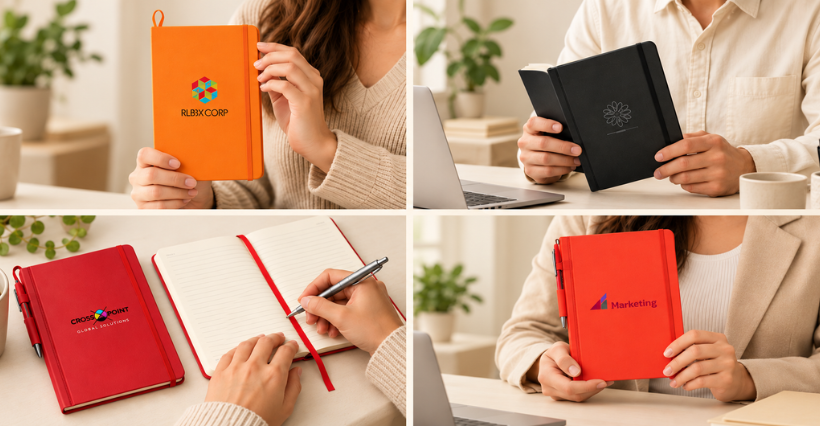
Your artwork needs to suit the available printing area. A detailed logo that looks clear on a folder may become difficult to read on a narrow pen barrel.
Ask your supplier which decoration methods work with the specific product. Depending on its surface, options may include printing, engraving, debossing, or foil decoration.
Before approving your proof, check:
- Logo spelling and proportions.
- Contrast between the artwork and product colour.
- Minimum readable text size.
- Placement and orientation.
- Website address or contact details.
- Consistency across every item in a set.
Supply vector artwork where requested and confirm colour requirements. A digital proof checks layout, but it cannot fully demonstrate the physical finish or exact colour appearance.
Stationery Buying Priorities
Beyond basic quality and audience preferences, consider material sourcing, personalization options, and features that may extend a product’s useful life. These details can help you compare products and make more informed purchasing decisions.
Recycled Materials and Clear Product Claims
Ask what proportion of the paper or cover is recycled and whether supporting documentation is available. If a product carries an environmental certification, confirm that it applies to the specific item being purchased.
Do not assume that a bamboo cover or kraft-paper finish automatically means a product has a lower environmental impact. Consider durability, packaging, and disposal options alongside the material description.
Personalization and Refillable Choices
Personalized notebooks can be suitable for employee welcome kits or client gifts. If individual names are added, confirm spelling, additional charges, and the approval process before production.
Refillable pens and notebooks with replaceable inserts may support longer use. Check whether compatible replacement components are available and convenient to obtain.
Compact Kits and Digital Connections
Build stationery kits around items recipients are likely to use. A notebook, pen, and folder can provide a practical set without unnecessary accessories.
A QR code can connect a notebook or folder to useful online resources. Test the printed code on multiple phones and include a short web address as an alternative.
Plan Your Budget and Delivery Together
Compare the total delivered price rather than the product’s advertised starting price. Setup, decoration, packaging, shipping, and applicable taxes can affect the final amount.
Ask for an itemized quote that confirms:
- Product and quantity.
- Number of print colours and locations.
- Artwork or setup charges.
- Sample and proof arrangements.
- Packaging or assembly requirements.
- Production time and shipping destination.
Your event date should guide the schedule. Allow time for sampling, artwork corrections, production, and shipping instead of treating dispatch as the same thing as arrival.
For a Toronto event or a shipment elsewhere in Canada, confirm the delivery postal code and receiving arrangements. Ask whether the timeline begins after artwork approval and whether your requested quantity is currently available.
Practical Examples for Your Next Campaign
The following scenarios illustrate product selection; they are not reported client case studies.
Conference example. If you are organizing a Toronto workshop, pair a compact notebook with a tested pen and print a resource link inside the cover. Your attendee receives writing tools during the session and a way to revisit the supporting material afterward.
Client meeting example. If you present proposals, choose a folder that fits your documents without bending them. Use consistent branding and include a clear next step inside, such as the contact details for discussing the proposal.
Track the outcome that matters to your campaign, such as resource visits or follow-up inquiries. Product distribution counts tell you how many items left your office, but do not prove business results.
Frequently Asked Questions
Which Promotional Stationery Products Are Most Useful?
Pens, notebooks, and notepads are practical starting points. Choose according to your recipient’s routine, then check writing comfort, portability, and product quality.
Can You Put Your Company Logo on Stationery?
Many stationery products support logo decoration. The method, artwork requirements, and available imprint area vary, so confirm the details for your chosen item.
How Much Does Branded Stationery Cost?
Pricing depends on the product, quantity, decoration, and delivery requirements. Request a complete quote to compare options fairly.
What Is the Minimum Order Quantity?
Minimum quantities differ between products and suppliers. Ask for the requirement for your selected stationery rather than assuming every item follows the same minimum.
How Can You Choose More Responsible Stationery?
Look for documented material claims, reliable construction, and practical reuse or refill options. Order quantities you can distribute purposefully and avoid unnecessary packaging.
Choose Stationery That Fits Your Business
Useful promotional stationery products begin with a clear purpose, suitable quality, and readable branding. When you plan the product and delivery together, your order is easier to assess and better suited to its recipient.
Contact Promotional Products Canada to discuss your audience, quantity, budget, and required delivery date. The business lists its mailing address as 250 Wincott Drive, PO Box 18535, Toronto, ON M9R 4C8.